Explore 4.25 How Bodies are Continuously Remade
Learning Objectives
By the time you have completed the 4.25. Introduction & Exploration Activities, you should be able to:
- Understand and be able to identify each of the following: stages/states (and transitions) of human development--infancy, childhood, adolescence, adulthood, old age; gene regulation, control genes, genetic mutations.
- Describe the role of gene regulation in the continuous recreation of bodies, including in the initiation and termination of the postnatal states of human development.
- Describe how a cell knows when, where, and for how long to activate, enhance, repress, or deactivate particular genes.
- Explain how gene regulation can produce significant differences between organisms that share much of their DNA--like chimpanzees and humans.
Scientific Terms/Concepts
Terms: Post-Natal Stages/States of Human Development (and the transitions that separate them), Infancy (stage/state), Childhood (stage/state), Adolescence (stage/state), Adulthood (stage/state), Old Age (stage/state), Gene Regulation, Control Genes, Genetic Mutations.
Define and give an example of each term:
Term:
Infancy
Definition:
Example:
Term:
Childhood
Definition:
Example:
Term:
Adolescence
Definition:
Example:
Term:
Adulthood
Definition:
Example:
Term:
Old Age
Definition:
Example:
Introduction
In the Introduction Activity, you thought deeply about the amazingly complex system that is your body and you explored the nature of each stage (state) that comprises the normal development of human bodies: infancy, childhood, adolescence, adulthood, and old age. Below, we identify the processes that continuously remake human bodies (and the bodies of all organism) both during developmental stages and during the transitions that separate them. We’ll begin with a thought experiment that will help you understand how amazingly dynamic bodies are—including your body.
Imagine someone you know well, a parent, a friend, a sibling, … choose anyone. Now, imagine you didn’t see them for an hour. Would you still recognize them? Of course! Would you recognize them after a day? A week? A month? Yes! You’d recognize them without a problem. Even if the individual you selected were a young person, you’d probably still recognize them—despite their having changed a lot.
Now, would you recognize this individual after a year or a decade? Record your answer in the space below.
Now, consider that the component parts—atoms, molecules, and cells—of the person you’re thinking of are continuously being replaced. In all bodies, cells continuously divide and die, and atoms and molecules continuously cycle through the body. To become more familiar with the rates of cellular overturn, think about the cells that comprise different parts of human bodies—such as skin, brains, intestines, blood, liver, kidney, heart, teeth, fat, lungs, & bones—and answer the following questions.
Is the person you selected above identical after a week, or have the cells that comprise some of their body parts been replaced?
How about after a month, what body parts are replaced during this period?
And after a year, what body parts are replaced during this period?
A decade?
Are there any parts of the human body that remain essentially unreplaced through most of life?
So, if most of the cells, tissues, or organs that comprise a human body (or the body of any organism) have been replaced, what is that you are recognizing when, after a decade, you recognize someone?
So, if what we recognize as a person is the pattern of their body and not the matter of their body, where does this pattern come from? In other words, what determines the pattern of each individual—be that individual a human, some other animal, or a plant? Briefly describe your thoughts below.
Control Genes
As you’ll recall, the processes by which bodies self-assemble, maintain themselves, and generate new bodies include those described in the table below.
| Process | Description |
|---|---|
| Energy Utilization (metabolism) | Taking in resources, process resources, and expel waste. Includes respiration, digestion, and excretion. |
| Boundary Maintenance & Internal Environmental Regulation (Homeostasis) | Creating and sustaining organismal conditions that are distinct from the environment |
| Adaptation to Environment | Responding to external stimuli |
| Reproduction | Asexually or sexually produce new offspring |
| Gene Regulation | Governing where and when genes are expressed |
We highlighted gene regulation—the orchestration of biological self-assembly—because this process governs the other processes.
Describe what genes do in the box below. (If you need a little review, watch this video.)This is an important answer. We encourage you to think deeply before and during your response. If you do, what we share with you in the answer will be more meaningful. Unless you already thoroughly understand gene regulation, your progress through the rest of this course will be stunted by skimming through this material. In other words, this is really important material—concepts that form the foundation for most of the rest of what we’ll discuss this course.
Gene Regulation
Describe the role of gene regulation in the continuous recreation of bodies, including in the initiation and termination of the states that comprise the postnatal development of an organism. Also, describe how a cell knows, at a specific time, which genes to activate and which to deactivate.
This video will give you some idea on how gene regulation and expression works:
Explain how gene regulation can produce significant differences between organisms that share much of their DNA (e.g., chimpanzees and humans).
What Causes Differences in Organisms?
Above, we learned how genetic changes (mutations) and the interactions of populations with their environments (inheritance, selection, & adaption) can cause populations to change. Before we explore another cause, let’s take a peek at the genetic similarities and differences between organisms. The table below shows how genetically similar you are to yourself, other humans, Neanderthals, and chimpanzees.
| Organism | Shared DNA |
|---|---|
| You | 100% |
| Other humans | ~99.9% |
| Neanderthals | ~99.7% |
| Monkey | ~93% |
| Fish | ~70% |
| House fly | ~60% |
Continue exploring the genetic similarities and differences between you and other organisms by answering the questions below.
How similar are your genes to those of monkeys and mice?
How similar are your genes to those of fish and flies?
How similar are your genes to those of single-celled eukaryotes and bacteria?
Now, we’re ready to explore another process that produces differences between organisms. To do this we’ll investigate the similarities and differences between humans, chimpanzees, & bonobos and the similarities and differences between homologous mammal limbs.
The first image below shows the bodies of chimpanzees and bonobos and allows you to compare these to human bodies. The other three images illustrate the genetic similarities between these three species. As you can see, chimps and bonobos are nearly genetically identical (~99.6% identical) and share similar bodies. However, humans and chimpanzees/bonobos have quite different bodies despite their tremendous genetic similarity (nearly 99% identical). How can this be? Don’t genes determine the shape of bodies? Well, the answer to that question is both ‘Yes!’ and ‘yes, but not just in the way most people think’. Here’s what we mean: differences in bodies result from two aspects of genes—which genes are there and how they’re used (expressed). So, two organisms—like humans and chimpanzees/bonobos—can have very similar genes but their bodies can have significant differences because those genes are used differently. Said another way, both genes and gene regulation cause differences in the characteristics of bodies.
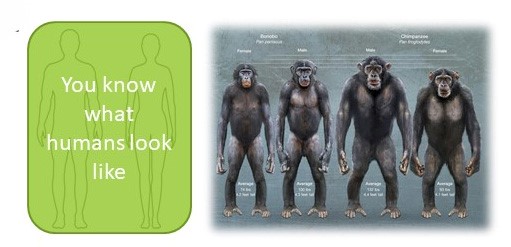
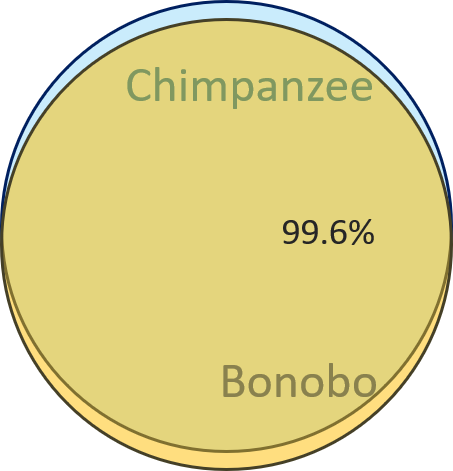

Think about it: identify a body part that chimps/bonobos have that humans don’t, or vice-versa. Do all of these organisms have a heart? Eyes? A brain? Arms & legs? A spleen? …. Yep! What causes the differences between these body parts across these species? Not just genes! Identical genes turned on for different periods in different locations can produce different shapes/aspects of the same body parts!!! This is an important idea; don’t continue until you understand that last sentence.
Alright, let’s think about this same thing—the role of gene regulation—in another context. The image below shows the now-familiar homologous limbs of several mammals. Look carefully at each limb. Compare the parts and pieces that comprise each limb. Are they all pretty much made of the same parts and pieces organized in the same ways? Yes, they sure are! So, ask yourself this question: could all of these limbs be produced by the same genes? If you’re like most people, you really want to say, “No way! That’s impossible! To produce such different body parts (wings, arms, fins, and legs) requires vastly different genes!” But knowing what you now know about gene regulation should cause you to answer the question differently, perhaps as follows, “The limbs in the image—and, in fact, those of all limbed animals—are made using pretty much identical genes that are controlled differently.” Pretty cool, right?!
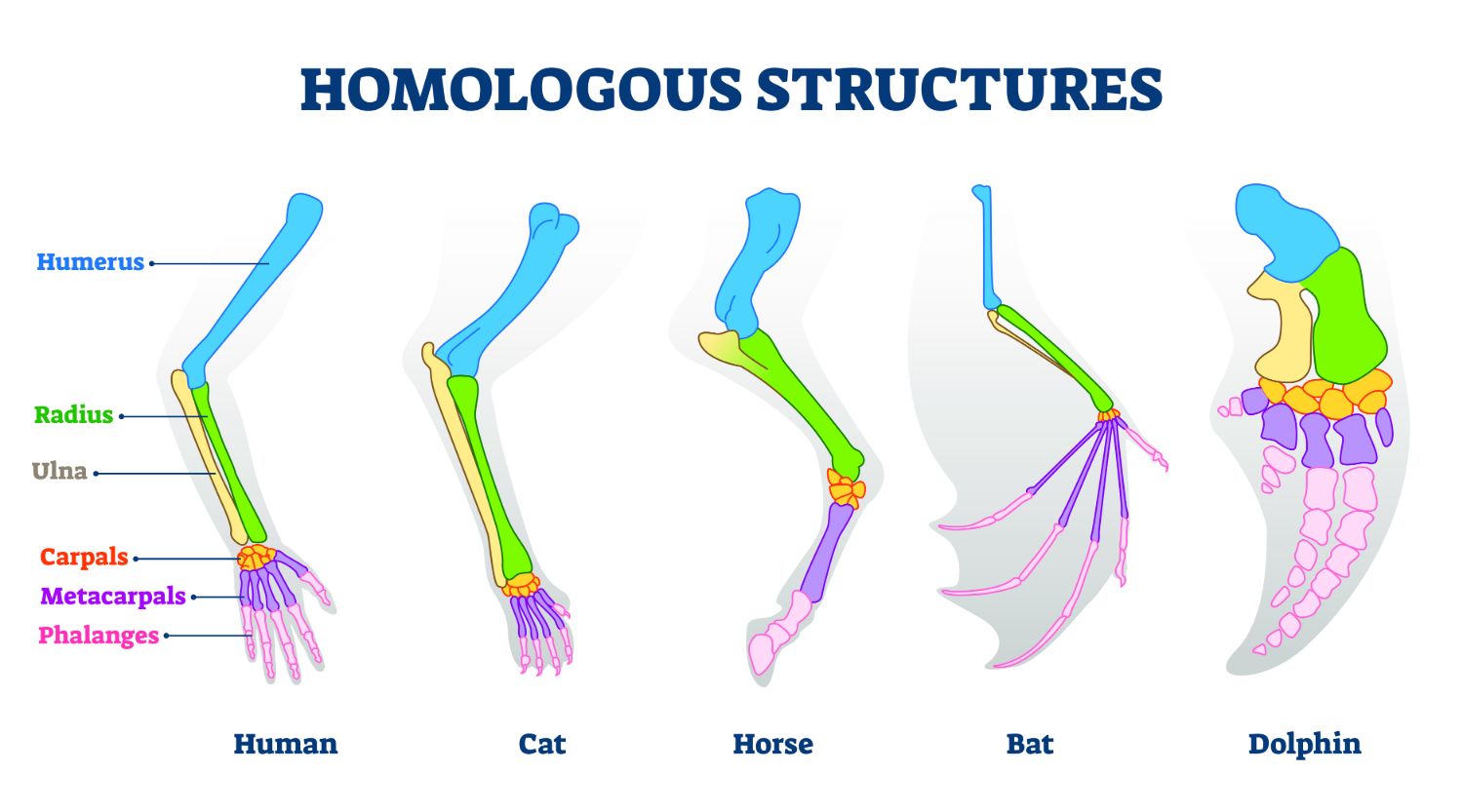
Perhaps this analogy will help you understand the role of gene regulation in producing homologous structures more deeply: the limbs of these organisms are like an orchestral performance. The instruments in the orchestra are like the genes that build homologous elements (limbs, hearts, brains, skulls, skin, kidneys, gonads, backbones, etc.) and the differences between homologous body parts are like the conductor signaling the instruments (genes) to play a particular note or sequence longer or shorter, louder or softer, etc. Make sense? We hope so. It’s a really important concept, if you want to understand how bodies are built.
Incidentally, one of the barriers to understanding evolution for many people is the notion that most differences between organisms require new genes. And that is simply not true!!! Small changes in the expression of control genes can produce large changes in the form and function of a body! (That’s another really important sentence. Read it again.)
For each bone in each organism, describe the result of gene expression (what it ultimately looks like).
| Human (Example) | Cat | Horse | Bat | Dolphin | |
|---|---|---|---|---|---|
| Humerus | Bone is longer bones of forearm and as thick as the radius and ulna together | ||||
| Radius/Ulna | Bones are nearly equal length and half as thick as the humerus | ||||
| Carpals | Bones are small and squarish | ||||
| Metacarpals | Bones are long and narrow to form the palm | ||||
| Phalanges | Each finger has three bones of decreasing length. |
