Explore 4.24 What Life Can Teach Us & How We Learn It
Learning Objectives
By the time you have completed the 4.24. Introduction & Exploration Activities, you should be able to:
Understand the meaning of the following terms/concepts and be able to identify examples of each: sequence of biological events, age of biological events, nature of biological events, molecular clocks, structure of biological materials, composition of organisms/biological materials, processes that modify biological materials.
Illustrate how important scientific interpretations of life are derived from scientific observations of biological materials such as fossil parts (teeth & bones), fossil traces (footprints & burrows), and biomolecules (genes & other biomolecules).
Identify what biological materials such as fossil parts (teeth & bones), fossil traces (footprints & burrows), and biomolecules (genes & other biomolecules) indicate about ancient organisms.
Given a biological material (e.g., genes or teeth), identify a likely biological event or process that generated that material or feature (e.g., descendancy or preferred food).
Understand how rocks and fossils record information about the environmental conditions that existed when they formed. In addition, identify a likely way a biological event (e.g., adaptation, speciation, or extinction) will be recorded for future observers.
Scientific Terms/Concepts
Terms: Sequence of Biological Events, Age of Biological Events, Nature of Biological Events, Molecular Clocks, Structure of Biological Materials, Composition of Organisms/Biological Materials, Processes that Modify Biological Materials.
Define and give an example of each term:
Term:
Sequence of Biological Events
Definition:
Answer: The order in which biological events occurred.
The order in which biological events occurred.
Example:
Answer: Single celled organisms before sea jellies before fish before elephants
Single celled organisms before sea jellies before fish before elephants
Term:
Age of Biological Events
Definition:
Answer: The time that has elapsed since the event occurred
The time that has elapsed since the event occurred
Example:
Answer: The first life on Earth appeared by 3.45 Bya
The first life on Earth appeared by 3.45 Bya
Term:
Nature of Biological Events
Definition:
Answer: Describing and interpreting the attributes of that event
Describing and interpreting the attributes of that event
Example:
Answer: Observing the structure and composition of biological materials to determine the source(s) of these materials and the natural process(es) that produced their observed characteristics.
Observing the structure and composition of biological materials to determine the source(s) of these materials and the natural process(es) that produced their observed characteristics.
Term:
Molecular Clocks
Definition:
Answer: These figurative clocks measure the time elapsed since two species diverged using the rate at which genetic differences appear.
These figurative clocks measure the time elapsed since two species diverged using the rate at which genetic differences appear.
Example:
Answer: Comparing DNA from living humans and great apes indicates that the last common ancestor of these organisms lived about 7 million years ago
Comparing DNA from living humans and great apes indicates that the last common ancestor of these organisms lived about 7 million years ago
Term:
Structure of Biological Materials
Definition:
Answer: The shape and arrangement of biological materials that determines their function at all scales, from molecules to organs.
The shape and arrangement of biological materials that determines their function at all scales, from molecules to organs.
Example:
Answer: The three dimensional shape of a protein allows it to act as a structural element, an enzyme, a transporter, or many other functions.
The three dimensional shape of a protein allows it to act as a structural element, an enzyme, a transporter, or many other functions.
Term:
Composition of Biological Materials
Definition:
Answer: The molecules, elements, and isotopes that comprise them and the relative abundances of attributes in a population of organisms in an ecosystem
The molecules, elements, and isotopes that comprise them and the relative abundances of attributes in a population of organisms in an ecosystem
Example:
Answer: The abundance of calcium in the shells of a population of molluscs to determine the successful growth of the population.
The abundance of calcium in the shells of a population of molluscs to determine the successful growth of the population.
Term:
Processes that Modify Biological Materials
Definition:
Answer: The structure and composition of biological materials are used to interpret the origins of those materials
The structure and composition of biological materials are used to interpret the origins of those materials
Example:
Answer: Replacement of body parts by available minerals can describe the nature of the hard parts of an organism and how they have changed over time.
Replacement of body parts by available minerals can describe the nature of the hard parts of an organism and how they have changed over time.
Biological Interpretations
Illustrate how important scientific interpretations of life are derived from scientific observations of biological materials such as fossil parts (teeth & bones), fossil traces (footprints & burrows), and biomolecules (genes & other biomolecules).
Identify what biological materials such as fossil parts (teeth & bones), fossil traces (footprints & burrows), and biomolecules (genes & other biomolecules) indicate about ancient organisms.
Given a biological material (e.g., genes or teeth), identify a likely biological event or process that generated that material or feature (e.g., descendancy or preferred food).
Observing & Interpreting Fossil Specimen 1
In the image above, the skull on the right is human and is placed there for scale. List several observations of the fossil specimen on the left in the space below.
Answer
The skull is large, has sharp teeth, different types of teeth, a long snout, forward facing eyes, a small brain case, a large bone arch below and behind its eye socket, and a large bone crest atop the skull.
Now, based on what you know about animals, interpret some of the observations identified above.
Answer
The large skull indicates a large body. The sharp teeth indicate it is a carnivore. The different types of teeth indicate it is a mammal. The long snout and general shape of the head indicates a dog-like organism. The forward-facing eyes indicate it is a predator. The small brain case indicates a relatively small brain. And the large bone arch (below and behind its eye socket) & the large bone crest atop the skull indicate the organism had large jaw muscles and a powerful bite.
The skull you observed and interpreted is a dire wolf, shown below. It originated ~125 kya and went extinct ~9.5 kya.
Observing & Interpreting Fossil Specimen 2
The skull in the image above is about 6 in (15 cm) across. List several observations of the fossil specimen in the space below.
Answer
The overall shape of the skull resembles a human skull, with notable differences: the brain case is small, the brow ridge is huge, the eye sockets are large, the face slants top to bottom and is snouty. Other observations are differentiated, human-like teeth.
Now, based on what you know about animals, interpret some of the observations identified above.
Answer
The human-like shape of the skulls shows that this organism is closely related to humans. Chimpanzees, which share ~98.5% of their DNA with humans, have skulls (and bodies) that are far more different from humans than this skull (and its associated body). Thus, these organisms are far more closely related to humans than chimpanzees. The teeth indicate an omnivorous lifestyle. The relative size of the brain is large compared to most other animals, but small compared to humans.
The skull you observed and interpreted is from Australopithecus afarensis, shown below. Australopiths were Earth’s first persistently bipedal hominin. They originated ~4.2 Mya and went extinct ~0.6 Mya.
Observing & Interpreting Fossil Specimen 3
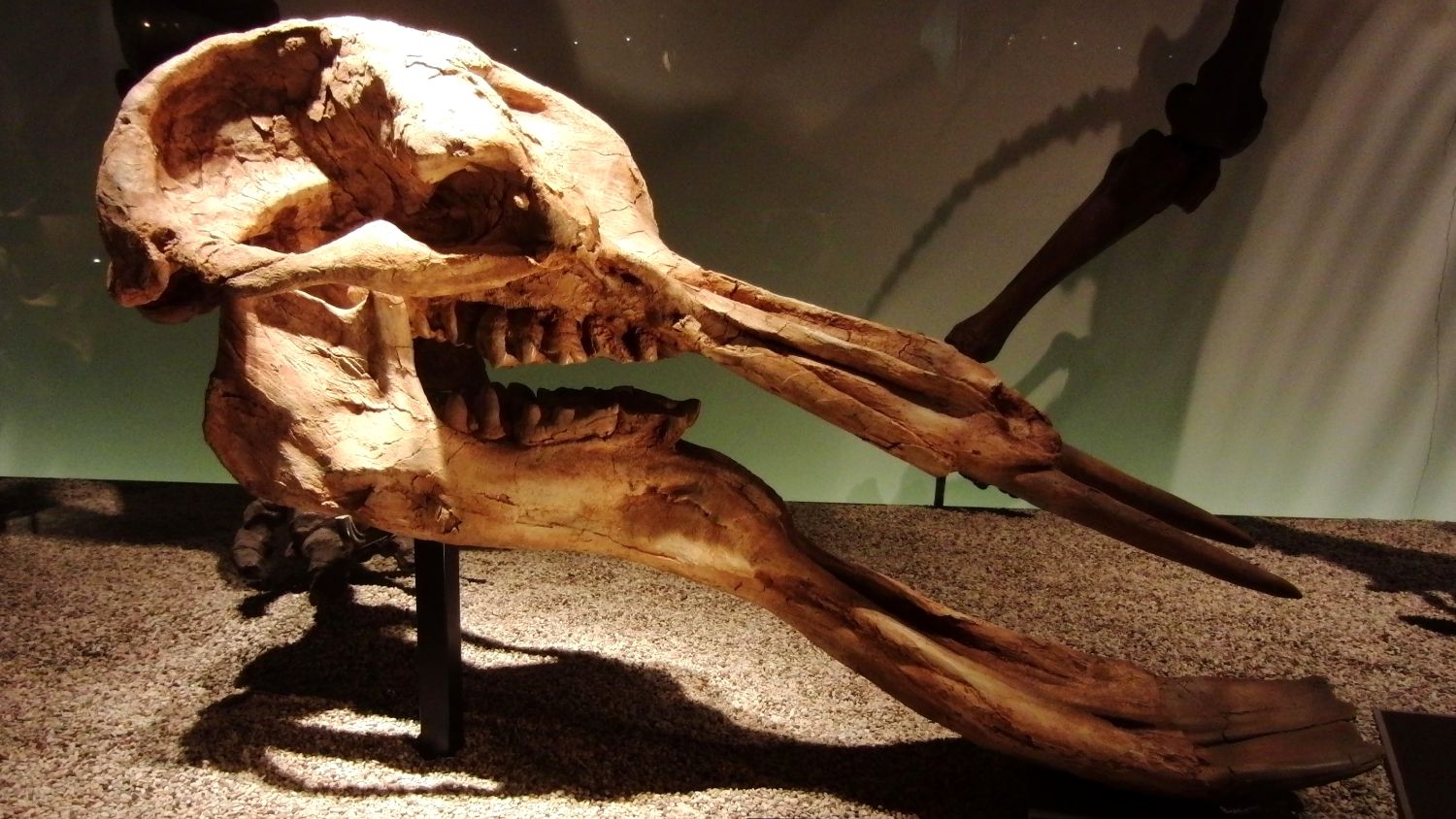
The skull in the image above is ~3 ft (1 m) long. List several observations of the fossil specimen in the space below.
Answer
This robust skull is large and has a protruding elongated jaw, huge molars, shovel-shaped lower jaw & teeth (incisors), and forward-pointing upper teeth (incisors).
Now, based on what you know about animals, interpret some of the observations identified above.
Answer
The large skull is shaped similar to the skull of a modern elephant. The large skull indicates a large body, the huge molars and shovel-shaped lower incisors indicate an herbivorous lifestyle, the different types of teeth indicate it is a mammal, and the long forward-pointing upper teeth (incisors) indicate the need to defend itself.
The skull you observed and interpreted is from Platybelodon, shown below. This elephant-like herbivore originated ~25 Mya and went extinct ~5 kya.
Although we’ve barely scratched the surface of what can be observed and interpreted from the above specimens, can you see how connections are made between fossil observations and interpretations? We hope so!
Fossil & Future Records
Understand how rocks and fossils record information about the environmental conditions that existed when they formed. In addition, identify a likely way a biological event (e.g., adaptation, speciation, or extinction) will be recorded for future observers.
Learning from Biomolecules such as Genes
As we mentioned earlier, the genetic makeup of individuals can be used to demonstrate relatedness (descendancy relationships). Did you know that humanity has learned how to extract biochemical and genetic information from relatively young fossils? The oldest DNA so far measured is from an ~1.7 Mya rhinocerous tooth. In some cases, it is possible to sequence the entire genome of ancient organisms, including extinct organisms. For example, in the last decades, humanity has sequenced the Neanderthal and Denisovan genomes. This information indicates that Homo sapiens (us) interbred with both of these species of extinct hominins—Homo neanderthalensis (Neanderthals) and Homo denisova (Denisovans). The image below illustrates periods of interbreeding that explain the observed genetic makeup of modern humans. We’ll talk more about this in Unit 5.
Like genes, the chemical and isotopic composition of biological materials are a treasure trove of information. Did you know that by measuring the composition of parts of your body (with your permission, of course!), we could tell you where you have lived and what kinds of foods you eat—without ever talking to or observing you? It’s true! Not only that, but we could do the same for other buried organisms with preserved tissue. That information—and so much more!—is recorded in the atoms and molecules that comprise the bodies of organisms. You might be interested to know that drug enforcement agencies around the world use measurements of the composition of illicit drugs to identify where the plants used to produce seized drugs were grown, which helps them understand trafficking routes. Pretty cool, isn’t it?
It is difficult to overestimate the vast amount and variety of information that is recorded by the elemental, isotopic, and molecular composition of biological materials!
Learning from Climate Records
We explored how rocks and other materials can record past climate conditions in the last unit. The image below illustrates common types of biological and geological materials that record climate information. It also shows the interpreted record of temperatures and carbon dioxide levels based on observations of ice layers in glacial.
Below, we illustrate what we’ve discovered above by identifying a few of the thing we can learn from fossils preserved at the bottom of an ancient lake in Wyoming and from a man preserved in ice for more than 5,000 years.
Learning About Ancient Wyoming
The images below show a few of the spectacularly preserved fossils recovered from rock layers in the Green River Formation exposed in Fossil Butte National Monument (southwestern Wyoming, USA). We introduced you to these fossils earlier.
Take a few minutes to think about the kinds of things that humanity could learn about the nature of southwestern Wyoming during the time these fossils formed. List your ideas below.
Answer
The organisms which formed these fossils were buried by lime mud in a large inland lake that existed in southwestern Wyoming, USA 53.5-48.5 Mya. During this period, Earth had an extreme greenhouse climate and southwestern Wyoming was much warmer and wetter than it is today. The images below illustrate interpretations of the aquatic and terrestrial environments that produced the fossils of the Green River Formation.
Learning About Ötzi the Iceman
In 1991, hikers found ‘Ötzi the Iceman’ frozen in glacial ice in the Italian Alps near the Austrian border. The images below show Ötzi before he was removed from ice (top left), the location where he was discovered (top right), and some of the clothing and weapons found with him (bottom row).
Take a few minutes to think about the kinds of things that humanity could learn about Ötzi by observing the characteristics of the biological materials that comprise his body and the manufactured items he was carrying when he died. List your ideas below.
Answer
After Ötzi’s discovery, officials carefully liberated his body and the associated artefacts from the ice and moved him to a University in Italy, where he was studied with great intensity by numerous scientists from around the world. The table below lists what humanity has learned thus far about Ötzi, and the photo shows a reconstruction of this fascinating individual. The column on the left identifies the type of observation made and the column on the right lists both the interpretations and—in parentheses—the observations upon which each interpretation is based.
Homo sapiens. 5’3” tall, weighted 110 lbs (measurements of the body)
Accustomed to long walks over hilly terrain (bone shape & wear)
45 years old; 61 soot tattoos in 19 groups of lines (observations of the body)
Died from arrow wound to the left shoulder, which caused a matching hole in his coat; bruises, cuts, & head trauma consistent with close-quarters fighting. Blood of 4 other people on him—blood from two on the arrow which he used to kill them, arrow retrieved after each kill; blood from one on the knife; & blood from one on the coat, consistent with carrying a comrade over his shoulder (visual and genetic observations of the body and blood)
Lived > 5,000 ya, 3100-3400 BC, during Copper age Europe (isotopic composition)
Grew up in Feldthurns (Italy) & later moved ~50 km N (isotopic composition)
Diet. Diet from previous several months (hair); Ate roots, grain, & fruit with Ibex meat >2 h before death and with chamois & deer ~8 h before death (contents of stomach and intestines)
Health. Sick three times in the 6 months prior to death (fingernails); cavities from high carb diet; lactose intolerant; had an intestinal parasite; some bone & joint degeneration. Died in spring or early summer (pollen)
Involved in copper smelting (high Cu & As—atomic & particles—in hair)
To date, 19 descendants have been identified (genetic makeup of living individuals in Tuscany)
Belongings
Grass cloak; Items hide-sewn with sinew - loin cloth, leggings, cap w/ strap, laced weatherproof snowshoes & grass ‘socks’, belt & pouch containing pyrite, flint, & dried fungus, small tools including a fire starter; Quiver, copper axe, knife, longbow & 14 arrows – 2 finished (materials)
We are continually impressed by the types and quality of information that can be discovered by studying the characteristics of organisms that live on Earth long ago. Before you move on, take a moment to consider what impresses or interests you most from the examples of past life used above, or from other examples with which you are familiar.