By the time you have completed the 3.22. Introduction & Exploration Activities, you should be able to:
Understand the meaning of the following terms/concepts and be able to identify examples of each: icehouse climate state, ice age, glacial period, interglacial period. Identify the Earth processes responsible for the glacial and interglacial periods of ice ages. Also, identify whether Earth is presently in a glacial or interglacial period of the modern ice age.
Describe, in terms of states and transitions, the development of Earth’s climate from the Mesozoic greenhouse to the late Cenozoic icehouse (and ice age).
Understand the context for modern, human-induced climate change and describe how it will be expensive & challenging for human civilization.
Answer: Icehouse climate states are periods when Earth is sufficiently cool to produce substantial continental ice.
Icehouse climate states are periods when Earth is sufficiently cool to produce substantial continental ice.
Example:
Answer: Currently Earth is in an icehouse climate state. Icehouse climate states exist when Earth climate is habitable but persistently cold—as during the last ~35 My. Earth’s habitable range is ~35o F (~20o C).
Currently Earth is in an icehouse climate state. Icehouse climate states exist when Earth climate is habitable but persistently cold—as during the last ~35 My. Earth’s habitable range is ~35o F (~20o C).
Term:
Ice Age
Definition:
Answer: Ice ages are more severe than icehouse climate states. They typically require ice caps at both poles.
Ice ages are more severe than icehouse climate states. They typically require ice caps at both poles.
Example:
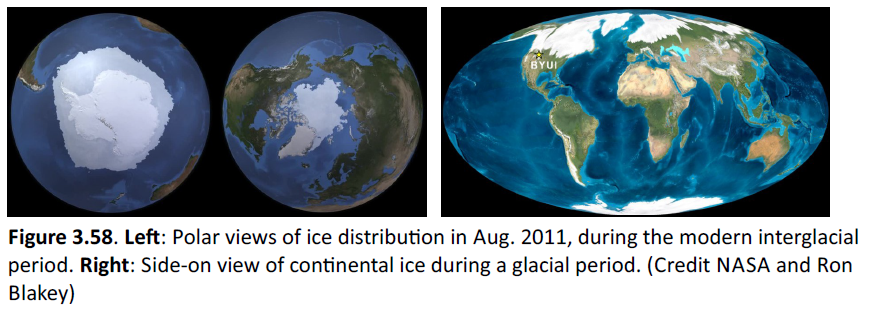
Answer: By ~2.6 Mya, continued cooling produced a northern ice cap (Figure 3.58)—which marked the beginning of the Pleistocene Ice Age.
By ~2.6 Mya, continued cooling produced a northern ice cap (Figure 3.58)—which marked the beginning of the Pleistocene Ice Age.
Term:
Glacial Period
Definition:
Answer: Inside ice ages, cyclical climatic variations produced by variations in Earth’s orbit cause glaciers to expand. This would be a glacial period.
Inside ice ages, cyclical climatic variations produced by variations in Earth’s orbit cause glaciers to expand . This would be a glacial period.
Example:
Answer: The last glacial period began ~115 kya, reached its maximum ~23 kya. During this glacial period ice sheets extended south of the US-Canada border in North America; covered Scandinavia, most of England and northern Russia in Eurasia; and Antarctica and much of the Andes in the southern hemisphere.
The last glacial period began ~115 kya, reached its maximum ~23 kya. During this glacial period ice sheets extended south of the US-Canada border in North America; covered Scandinavia, most of England and northern Russia in Eurasia; and Antarctica and much of the Andes in the southern hemisphere.
Term:
Interglacial Period
Definition:
Answer: Inside ice ages, cyclical climatic variations produced by variations in Earth’s orbit cause glaciers to retreat. This would be an interglacial period.
Inside ice ages, cyclical climatic variations produced by variations in Earth’s orbit cause glaciers to retreat. This would be an interglacial period.
Example:
Answer: The Holocene interglacial period ~11.7 kya is a good example of an interglacial period. Our modern verdant Earth lies in the Holocene Interglacial Period of the Pleistocene Ice Age, inside the Late Cenozoic Icehouse Climate.
The Holocene interglacial period ~11.7 kya is a good example of an interglacial period. Our modern verdant Earth lies in the Holocene Interglacial Period of the Pleistocene Ice Age, inside the Late Cenozoic Icehouse Climate.
Identify the Earth processes responsible for the glacial and interglacial periods of ice ages. Also, identify whether Earth is presently in a glacial or interglacial period of the modern ice age.
Climate from Mesozoic to Cenozoic
When did the cooling that marked the beginning of the transition out of the Mesozoic Greenhouse Climate State begin?
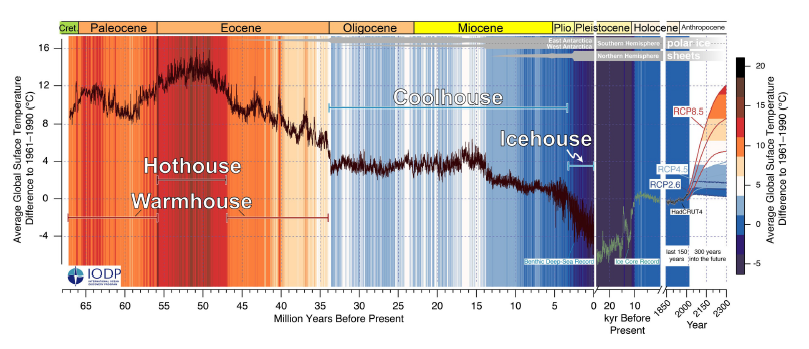
Answer: As you can see, the early Cenozoic was a time of extreme greenhouse conditions. During this time, palm trees and alligators existed in subarctic areas. The beginning of the transition out of the Mesozoic Greenhouse Climate State began about 50 Mya.
As you can see, the early Cenozoic was a time of extreme greenhouse conditions. During this time, palm trees and alligators existed in subarctic areas. The beginning of the transition out of the Mesozoic Greenhouse Climate State began about 50 Mya.
Human-Induced Climate Change
What is the general trend of Earth’s temperature over the last 5 million years?
Answer: Over the last ~5 million years, Earth’s temperatures have trended towards ever-cooler values.
Over the last ~5 million years, Earth’s temperatures have trended towards ever-cooler values.
What notable feature characterizes the temperature of Earth since 11.7 ka and sea level since ~7 ka?
Answer: The temperature of Earth since 11.7 ka and sea level since ~7 ka have been remarkably constant. Although Earth has experienced many such periods of relative stability, the norm for Earth is change. These plots provide deep insight into humanity’s historical attitudes towards climate. Written history—the last ~5500 y—has passed inside this period of relatively constant sea level and temperature. Although humans (Homo sapiens) have lived through the climate changes associated with the coming and going of at least two complete glacial-interglacial cycles, the lack of a written record means that humanity entered the modern age with essentially no memory of the types of climate change that are normal for Earth. This reality explains the perspectives of some sectors of modern society towards climate change.
The temperature of Earth since 11.7 ka and sea level since ~7 ka have been remarkably constant. Although Earth has experienced many such periods of relative stability, the norm for Earth is change. These plots provide deep insight into humanity’s historical attitudes towards climate. Written history—the last ~5500 y—has passed inside this period of relatively constant sea level and temperature. Although humans (Homo sapiens) have lived through the climate changes associated with the coming and going of at least two complete glacial-interglacial cycles, the lack of a written record means that humanity entered the modern age with essentially no memory of the types of climate change that are normal for Earth. This reality explains the perspectives of some sectors of modern society towards climate change.
When carbon-based materials (petroleum, coal, wood, coal, paper, etc.) are burned, what gases are produced?
Answer
Carbon dioxide & water vapor are produced when carbon-based materials (petroleum, coal, wood, coal, paper, etc.) are burned.
As you use the energy that fuels the things and activities that comprise your life, what impact does this have on climate?
Answer
Nearly all the energy we use to fuel the things and activities that comprise our lives results from burning fossil fuels. This moves carbon from solid Earth to the atmosphere much faster than natural systems can remove carbon dioxide. As a result, levels of carbon dioxide in the atmosphere rise, causing global temperatures to rise, which modifies local climates.
Climate Activity 3
Assuming you heeded our invitation to think deeply about your current perspectives on Creation, what follows may be somewhat anticlimactic. If it is, we welcome you back from inspiring realms of reflection to workaday efforts to develop your understanding of Earth’s habitability.
The third climate simulator activity provides you with opportunities to deepen your understanding of Earth’s climate system by guiding you through two important scenarios: 1) increasing volcanic activity, starting in an icehouse climate state and 2) increasing mountain building & reducing volcanic activity, starting in a greenhouse climate state. These scenarios, which we explored earlier in the unit, illustrate how Earth entered and exited the Mesozoic Greenhouse Climate. More broadly, they illustrate how Earth enters and exits greenhouse states.
To complete Climate Activity 3
Open Climate Activity 3 in one window, using the link in this week’s instruction page.
Open the Climate Simulator in another window, by clicking on the ‘Open Simulation’ button on the Climate Activity 3 home page. Avoid causing problems for yourself by following the instructions for opening the climate simulator that are found in the Introduction to the Climate Simulator section of Introduction Activity 3.6. Placing the Activity & Simulator windows side-by-side will make the activity easier.
Follow the instructions in Climate Activity 3, page by page. The activity consists of three sections: Preparation, Requirement 1, and Requirement 2. Use the ‘Menu’ section of the Activity window and the ‘PREV’ & ‘NEXT’ buttons to navigate through Climate Activity 3 and to assess your progress. You can identify completed pages using the Menu area: uncompleted pages have black titles; completed pages have gray titles.
When you are finished exploring, take the Climate Activity 3 Quiz.