By the time you have completed the 1.3. Introduction & Exploration Activities, you should be able to:
Understand the following about scientific theories: how falsification is used in science, the meaning/utility of falsified scientific theories; and how new scientific theories emerge from earlier theories.
Illustrate how scientific theory succession occurs using the transition from Earth- to Sun-centered theories of the Universe and the transition from Newton’s Theory of Gravitation to Einstein’s Theory of Relativity.
Scientific Theories and Falsification
Modern humanity recognizes that false or limited explanations can be useful in restricted settings. While the theory of gravity has been falsified, it can still be useful in science. Gravity is a valid description of why everyday objects fall - so long as you don’t need to describe the motion of the falling object with tremendous accuracy.
Read the articles below about falsification in science. Then answer the accompanying question:
Scientific theory should make predictions which can be tested, and the theory rejected if these predictions are shown not to be correct. Popper argued that science would best progress using deductive reasoning as its primary emphasis, known as critical rationalism.
If the Theory of Gravity was true, how can it now be false?
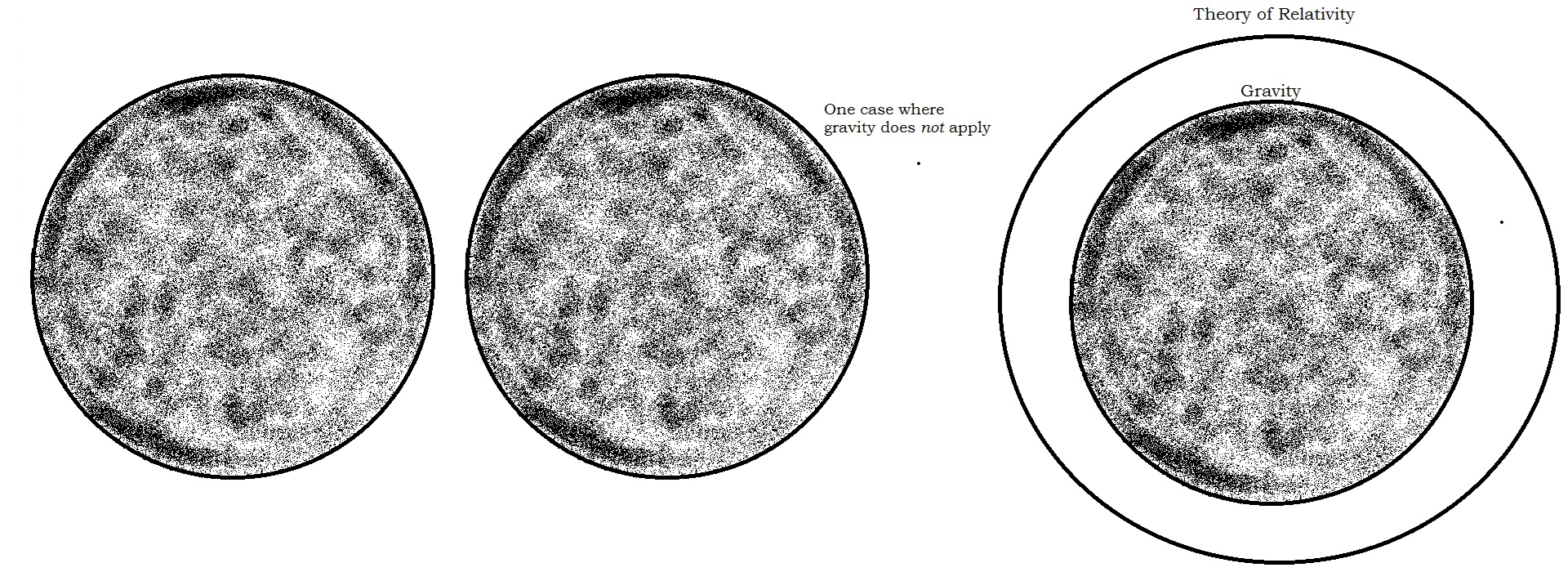
In our reading we saw three images to help us understand the Theory of Gravity and how it could be falsified.
Give an example of a time when using the Theory of Gravity would still apply:
Answer
Anytime you drop something in front of you and it falls to the earth, you can see gravity working. Gravity is successful at describing how objects move in many situations. It successfully describes most aspects of how planets move, why things fall, and the trajectory of thrown objects.
Give an example of a time when using the Theory of Gravity helped make an accurate prediction:
Answer
The discovery of the planet Neptune happened because of predictions made based on the Theory of Gravity. Astronomers could not understand why Uranus had an irregular orbit. They made the assumption that another planet may have a gravitational pull that accounted for it. In this case, they were correct and Neptune was discovered.
Give an example of a time when using the Theory of Gravity would be falsified:
Answer
Uranus isn’t the only planet observed to have an irregular orbit. Mercury does as well. When astronomers tried the same solution that worked when discovering Neptune, they were disappointed. It didn’t work. Gravity could not accurately explain what was happening with something moving that fast. Thus, Gravity Theory cannot describe all related aspects of the natural world.
Scientific Theory Succession
Theories are extensively tested explanations of nature that make testable predictions and guide future inquiry. Sometimes theories are falsified, as was previously mentioned with gravity. Sometimes scientists need to replace a less-true preparatory truth with a more-true preparatory truth in the search for absolute truth. This is where theory succession comes into play. New scientific theories can emerge from earlier theories.
Please watch this video (18 minutes) on falsification of theory involving cosmology, or the nature of the Universe.
Place the following scientists in order of their theories. Then add the appropriate description of the theory.
Scientists
Theories
Albert Einstein
The material universe consists of 5 elements – earth, water, air, fire, and quintessence
Plato
Sun-centered model of the universe
Aristotle
Theory of Gravity
Galileo Galilei
Theory of Relativity
Isaac Newton
All objects fall at the same rate (in the absence of air)
Johannes Kepler
Planets follow oval (elliptical) paths
Nicolas Copernicus
Celestial objects move in perfect circles
Tycho Brahe
The heavens change
Scientist:
Answer
Plato
Theory:
Answer
Celestial objects move in perfect circles
Plato argued that celestial objects like the Sun, Moon, and planets could only move in perfect circles, because they were perfect objects and, as such, their motion must follow a perfect circle.
Scientist:
Answer
Aristotle
Theory:
Answer
The material universe consists of 5 elements – earth, water, air, fire, and quintessence
Aristotle used the scientific underpinnings that the universe consisted of these five elements. His underpinnings contained some partial truths. But there were some gross inaccuracies. For example, atoms are the elements that comprise the material universe, not these elements.
Scientist:
Answer
Nicolas Copernicus
Theory:
Answer
Sun-centered model of the universe
Copernicus considered Aristotle’s system to be a ‘monster’ and ‘offensive to common sense’. He used mathematics to create a sun-centered model of the universe.
Scientist:
Answer
Tycho Brahe
Theory:
Answer
The heavens change
Tycho made observations of comets and a new star to demonstrate that the heavens change. These observations falsified the Aristotelian assertion that the heavens are eternally unchanging.
A fun fact about Tyco Brahe is that he lost the end of his nose in a duel with a sword and made a brass prosthesis to hide the nasal cavity and septum.
Scientist:
Answer
Johannes Kepler
Theory:
Answer
Planets follow oval (elliptical) paths
Kepler used the observations made by Tycho to develop his theory that planets follow elliptical paths. He determined that if Plato was wrong about that, he may have been wrong about other things as well.
Scientist:
Answer
Galileo Galilei
Theory:
Answer
All objects fall at the same rate (in the absence of air)
Galileo was the first person to make observations using a telescope. He was able to observe that the universe changes. This helped him in the development of his theory.
Scientist:
Answer
Isaac Newton
Theory:
Answer
Theory of Gravity
Newton developed the Theory of Gravity, which was the first theory to explain the natural processes that produce the Sun-centered system. His ideas made numerous highly testable predictions, things we should see in the universe if his ideas are true.
Scientist:
Answer
Albert Einstein
Theory:
Answer
Theory of Relativity
More than a century ago, Einstein demonstrated that Newton’s Theory of Relativity is false. This led the way for his Theory of Relativity, which allows us to accurately describe how nature is in situations where the Theory of Gravity doesn’t apply (for example at extreme speeds).
What is gravity? This video (10 minutes) will help you understand gravity with respect to Einstein’s Theory of Relativity.
Watch this video (4.5 minutes) to better understand the transition from the theory of gravity to the theory of relativity.